

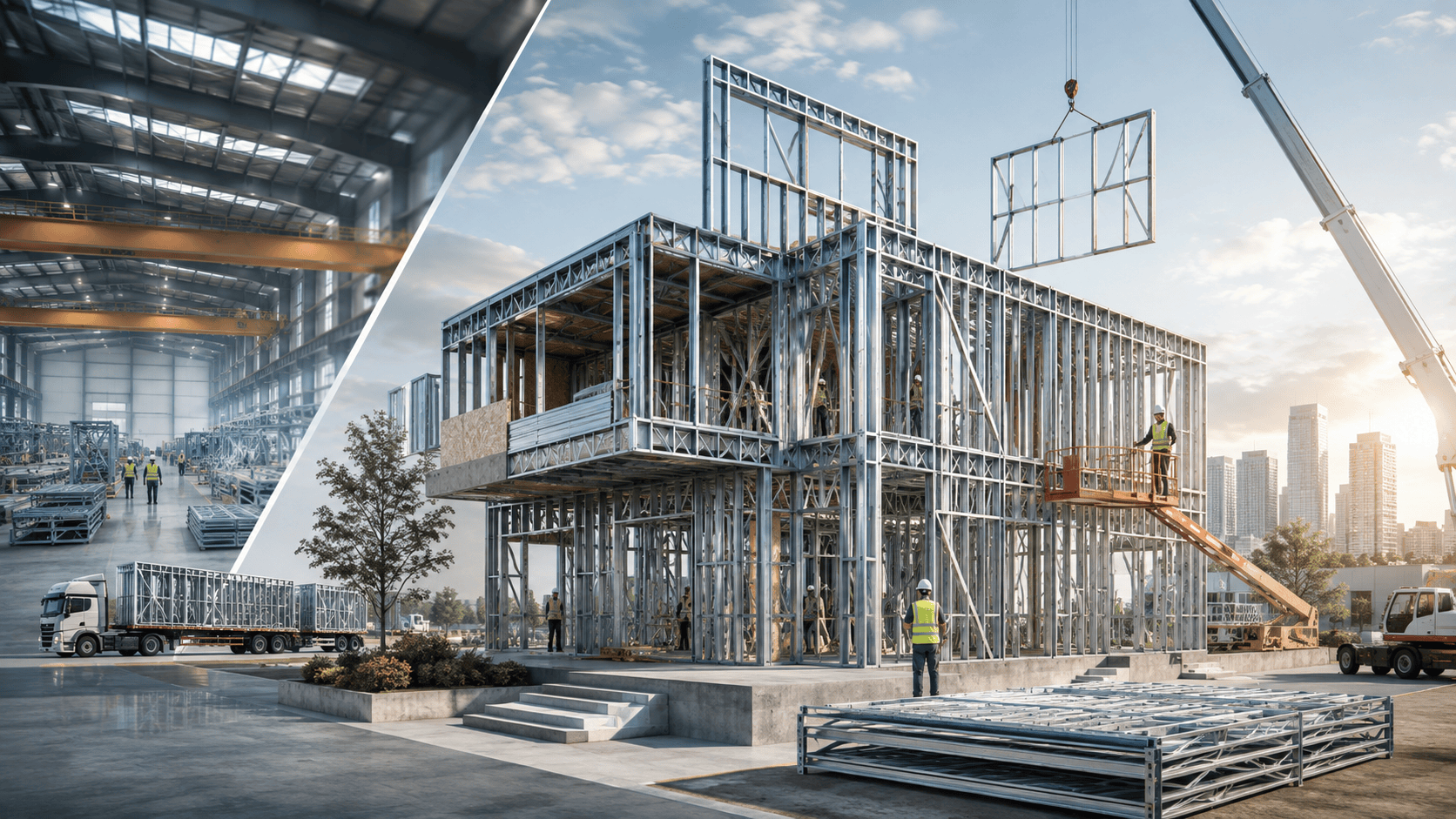
How Will the Buildings of Tomorrow Be Built?
Exploring the Potential of LSF and the Path Toward Industrialized Construction
Introduction
The construction industry is changing.
Rising construction costs, the need to reduce project timelines, greater demand for consistent quality, and the importance of using materials and human resources more efficiently are pushing the industry toward industrialized construction methods and modern technologies.
Under these conditions, the key question is no longer whether buildings will continue to be constructed in the future. The real question is:
How will the buildings of tomorrow be built?
Should the entire construction process continue to take place on-site using conventional methods, or can a significant portion of the process be transferred from the construction site to the factory, where engineering precision, industrial production, and quality control can enable buildings to be delivered faster and with greater accuracy?
The move toward industrialized construction is, in many ways, a response to exactly this challenge.
Modern building systems such as LSF (Light Steel Frame) can play an important role in transforming the way buildings are designed and constructed. When properly designed and executed, LSF makes it possible to manufacture a significant portion of structural components in a controlled factory environment and subsequently transport them to the project site for assembly and installation.
However, technology alone is not enough.
Owning a machine or offering LSF services does not necessarily mean having true manufacturing capability. A successful LSF project requires a combination of engineering expertise, precise calculations, specialized equipment, qualified personnel, defined manufacturing processes, quality control systems, and practical execution experience.
For this reason, the LSF industry must distinguish between selling a system, executing a project, and genuinely manufacturing a structure.
A true manufacturer must be capable of managing the entire path from engineering design to the final product — converting engineering data into accurate, physical, assembly-ready components, inspecting and preparing those components, transporting them to the project site, and integrating them into the construction process.
From Drawings to Structure: When Engineering Meets Manufacturing
One of the most important challenges in LSF projects is establishing a precise connection between design, manufacturing, and execution.
In a professional workflow, engineering design and structural calculations should never be separated from the manufacturing process.
Design details must be developed in a way that allows them to be transformed into real structural components, while those components must also be manufactured with sufficient accuracy to enable efficient assembly at the project site.
A complete LSF workflow can therefore be defined as a clear sequence:
Engineering Design & Calculations → Industrial Manufacturing → Quality Control → Coding & Preparation → Transportation → Assembly & Installation
Every stage of this chain directly affects the next.
A weakness in any part of the process can influence the quality, accuracy, and speed of subsequent stages.
For this reason, expertise in LSF is not limited to structural design or factory manufacturing alone. What truly defines a capable LSF manufacturer and contractor is the ability to manage the entire chain as one integrated process.
Experience: An Essential Part of Real Manufacturing
LSF technology can be learned. Equipment can be purchased. A production line can be established.
But real-world execution experience develops over time.
Experience means understanding the challenges that emerge during actual projects — from engineering and manufacturing to transportation, installation, assembly, coordination between different teams, and the management of varying site conditions.
This is where a company’s track record becomes significant.
Aria Tadbir Paj Engineering & Trading Company has been active in the construction industry for more than two decades and has expanded its specialized capabilities in the design, manufacturing, and execution of Light Steel Frame structures.
Today, the company has completed more than 450 projects across a wide range of sectors, including residential, educational, healthcare, administrative, and industrial developments.
This number represents far more than a statistic.
Each completed project contributes practical knowledge and experience that can be carried forward from one project to the next.
Real LSF Manufacturing: More Than a Title
In the Light Steel Frame market, simply using the title of an “LSF manufacturer” does not necessarily reflect the actual capabilities of a company.
True manufacturing requires a factory, specialized machinery, experienced personnel, defined manufacturing procedures, and an effective quality control system.
At Aria Tadbir Paj, LSF structures move directly from the engineering design and calculation stage into the manufacturing process. Once produced, components are inspected, prepared, and organized for transportation and subsequent project execution.
This direct connection between engineering and manufacturing makes it possible to manage the project in a more integrated and controlled manner.
Simply put:
We do not merely claim to be an LSF manufacturer — we manufacture LSF structures.
For Aria Tadbir Paj, this is not an advertising slogan. It is a description of the company’s actual operational structure.
Experience Beyond Iran
Aria Tadbir Paj’s activities have not been limited to the domestic market.
Structures manufactured by the company have also been supplied and implemented in international markets, including the United Arab Emirates, Kazakhstan, Armenia, and Greece.
International projects require more than manufacturing capability.
They involve managing a combination of preparation, packaging, transportation, project coordination, and on-site structural assembly in the destination country.
These projects have expanded the company’s experience beyond the domestic market and strengthened its practical capabilities in managing cross-border construction projects.
Educational Projects: Experience Under Real Project Conditions
Educational facilities represent another important part of Aria Tadbir Paj’s project portfolio.
The company has participated in several educational construction projects, including:
six three-classroom schools in the Izeh and Baghmalek regions, two six-classroom schools in Andika, the six-classroom Bamdazh School in Ahvaz, and a six-classroom school in Bandar Khamir.
Educational construction projects are often associated with specific scheduling and execution requirements.
This makes efficient production planning, logistics, coordination, and on-site execution particularly important.
Experience gained through projects of this nature has contributed to the company’s broader capabilities in implementing modern building systems under real-world conditions.
Integration: From Engineering to Execution
One of the key requirements for the continued development of LSF construction is strong integration between different stages of a project.
In an integrated organization, engineering, manufacturing, quality control, and construction do not operate as separate processes.
Instead, each stage is a continuation of the previous one.
At Aria Tadbir Paj, this chain can be summarized in four main stages:
Engineering:
Structural design and calculations tailored to the specific requirements of each project.
Manufacturing:
Transforming engineering designs into physical structural components.
Quality Control:
Inspection, verification, coding, and preparation of components before shipment.
Execution:
Assembly and installation of the structure at the project site.
This integration enables better coordination between engineering drawings, factory production, and site execution while providing a more unified approach to the overall construction process.
The Future of Construction: Moving from the Site to the Factory
The construction industry is moving toward a future in which an increasing portion of the building process will be completed before materials and components even reach the project site.
Factory-based manufacturing, digital design, greater precision, reduced material waste, faster project delivery, and improved schedule management are among the factors shaping the industrialization of construction.
Within this transformation, LSF can serve as one of the important construction technologies.
However, its true value becomes evident only when technology is combined with knowledge and practical experience.
Technology + Engineering + Manufacturing + Execution
It is the combination of these elements that can transform a building system from a product or concept into a practical construction solution.
Conclusion
The building of tomorrow will not necessarily be defined only by new materials or different construction techniques.
It may instead be the result of a fundamental change in the way we think about the construction process itself.
The transition from construction sites to factories, from conventional building methods to industrial production, from fragmented decisions to integrated project management, and from individual experience to organized institutional knowledge are all part of this transformation.
LSF can demonstrate its full potential within this transformation only when it is supported by engineering design, real manufacturing capabilities, quality control, and practical project execution experience.
Over more than two decades of activity, Aria Tadbir Paj has worked to bring these elements together — from engineering design and calculations to manufacturing, from manufacturing to quality control, and from the factory floor to the construction site.
More than 20 years of experience, over 450 completed projects, and participation in both domestic and international projects represent part of the path the company has followed.
Ultimately, the future of the construction industry does not belong to technology alone.
It belongs to organizations capable of combining technology with engineering knowledge, real manufacturing capabilities, and practical execution experience.
And perhaps this brings us back to the answer to the question posed at the beginning of this article:
The building of tomorrow will be designed and manufactured more precisely in the factory — and assembled more intelligently and efficiently on the project site.
Aria Tadbir Paj
Designer, Manufacturer, and Contractor of Light Steel Frame (LSF) Structures
20+ Years of Experience | 450+ Projects | Domestic & International Experience
From Iran, Building for the World

No comment