

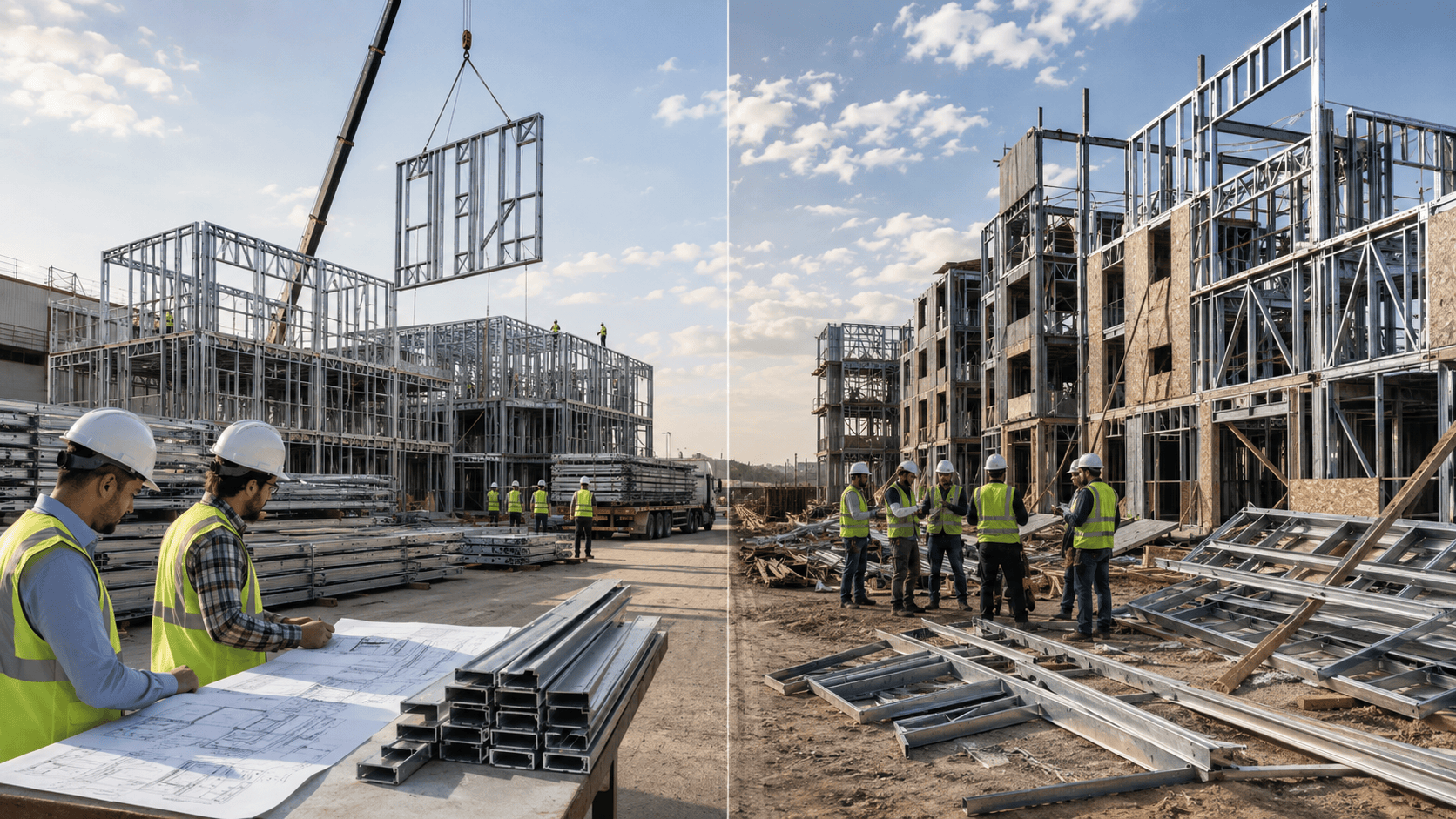
Why Do Some LSF Projects Succeed While Others Fail?
7 Key Factors That Determine the Success of a Light Steel Frame Project
Introduction
In recent years, the construction industry has increasingly moved toward modern and industrialized building methods.
The growing need for greater execution accuracy, better schedule management, consistent quality control, and optimized construction processes has made LSF (Light Steel Frame) one of the systems receiving increasing attention across a wide range of construction projects.
However, experience from different projects shows that simply choosing LSF does not guarantee success.
Two projects may begin with the same construction technology, yet one may be completed with the desired quality, proper scheduling, and a well-organized execution process, while the other faces challenges such as delays, rework, poor coordination, or rising costs.
Therefore, the real question is not whether LSF is a suitable construction system.
The more important question is:
What makes some LSF projects successful while others fail to achieve the same results?
The answer lies in a combination of interconnected factors — factors that begin at the earliest stages of engineering design and continue all the way through the final stages of structural installation.
1. Engineering Design and Structural Calculations: The First Step Toward Success
Every building is designed before it is built.
In LSF projects, the final quality of the structure is directly related to the accuracy of the engineering design and calculations.
Architectural requirements, load conditions, technical specifications, building usage, and execution details must all be considered during the design process.
The components that are eventually manufactured in the factory are, in fact, the physical outcome of engineering information and engineering decisions.
The more accurate these decisions are, the more coordinated the manufacturing and construction process will be.
For this reason, the first major investment in a successful project is neither steel nor machinery.
It is engineering knowledge.
2. Selecting the Right Structural System
LSF is not a one-size-fits-all solution.
Every project has its own unique conditions, and the selection of sections, thicknesses, connections, wall systems, floor systems, and construction details should be tailored to the specific requirements of that project.
In some cases, the difference between a successful project and a challenging one does not lie in the LSF system itself, but rather in the incorrect selection or design of its details.
Coordination between architecture, structural engineering, and the execution method is particularly important because every part of the building must function as part of one integrated system.
A structural system performs properly only when all of its components are designed specifically for the project in which they will be used.
3. Manufacturing Accuracy: Where Drawings Become Reality
Once the design is complete, one of the most critical stages begins: transforming engineering information into physical components.
Industrial LSF manufacturing is far more than simply forming steel sheets.
Every component must be manufactured according to engineering data, identified correctly, and prepared for the assembly stage.
High manufacturing accuracy allows components to be assembled more efficiently on-site while reducing the likelihood of unnecessary corrections, modifications, and rework.
In a professional manufacturing process, several important stages are involved:
- Converting engineering drawings into structural components
- Accurate production of profiles and sections
- Verification of component specifications
- Coding and identification
- Preparation for transportation
This level of manufacturing discipline plays an important role in the final quality of project execution.
4. Coordination Between Engineering, Factory, and Site Execution
One of the most important characteristics of successful projects is effective communication between the three main parts of the process:
Engineering, Manufacturing, and Execution
When each department operates independently, without sufficient coordination with the others, the likelihood of inconsistencies increases.
However, when engineers understand the manufacturing process and the factory understands the practical requirements of site execution, decisions become more realistic, accurate, and effective.
At the same time, the experience of the installation team can provide valuable feedback to the engineering and production departments.
This feedback can then be used to improve future projects.
This continuous connection is one of the fundamental principles of truly industrialized construction.
5. Planning: How Is Real Speed Achieved?
Speed is one of the most frequently mentioned advantages of LSF construction.
However, true construction speed does not depend only on how quickly components can be manufactured.
If the engineering design is not ready, if production is not coordinated with the construction schedule, or if components are not transported to the project site at the right time, even the strongest manufacturing capacity cannot optimize the project timeline.
Speed becomes meaningful only when the entire project chain operates in coordination:
Design → Manufacturing → Quality Control → Preparation → Transportation → Assembly → Execution
Under these conditions, project duration is not determined by the speed of a single department.
Instead, it is managed through the coordination of the entire process.
6. Experience in Real Construction Projects
Technical knowledge is valuable, but real-world experience is something different.
Construction projects rarely proceed under completely ideal conditions.
Site limitations, transportation challenges, workforce coordination, environmental conditions, design changes, and many other factors can affect the progress of a project.
A company that has completed numerous projects under different conditions will generally have a deeper understanding of these challenges.
Experience comes from direct involvement in real projects, and over time it becomes a valuable asset that improves decision-making in future projects.
For this reason, a company’s project execution track record is an important factor when assessing its actual capabilities.
7. Quality Control: A Process That Begins from the Start
Quality control should not be limited to the final stage of a project.
In a well-structured process, quality control begins during design and continues through manufacturing, preparation, transportation, assembly, and execution.
Reviewing design specifications, inspecting manufactured components, verifying compliance with drawings, and supervising the assembly process are all part of a complete quality control system.
The primary purpose of quality control is not simply to identify mistakes after they occur.
Its true purpose is to prevent errors from being transferred from one stage of the project to the next.
The earlier an error is identified, the easier, faster, and more economical it is to correct.
What Does a Successful LSF Project Look Like?
When these seven factors are considered together, a clear picture of a successful LSF project emerges.
A successful project is one in which:
- Engineering design is based on accurate structural calculations.
- The structural system is selected according to the specific needs of the project.
- Components are manufactured with industrial-level precision.
- Engineering, manufacturing, and site execution are properly coordinated.
- Production and transportation schedules are aligned with the overall project timeline.
- The execution team has experience in real-world projects.
- Quality control is maintained throughout all stages of the process.
Under these conditions, LSF is no longer simply a construction product.
It becomes an organized and engineered construction process.
Informed Selection Matters More Than the Lowest Price
When selecting an LSF contractor or supplier, clients are often presented with multiple proposals.
Naturally, price and delivery time are important considerations.
However, these two factors alone do not necessarily indicate the true quality of a project.
Several simple questions can provide a much clearer picture of a company’s actual capabilities:
Who is responsible for the engineering design of the project?
Where are the structural components manufactured?
How is quality control managed?
How much experience does the company have with similar projects?
Can the factory and previously completed projects be inspected?
Is there a clear and integrated connection between engineering, manufacturing, and execution?
The answers to these questions can often be far more valuable than simply comparing the headline prices of different proposals.
Experience Is Valuable When It Can Be Seen
Ultimately, the strongest evidence of a company’s capabilities is often not found in its advertising.
It can be seen in the factory it operates, the components it manufactures, and the projects it has completed.
Years of activity in the construction industry become meaningful when that experience has been tested in real projects and can be transformed into better knowledge and better decision-making in future work.
In Iran, several companies have developed long-term experience in the design, manufacturing, and execution of LSF systems.
One of these companies is Aria Tadbir Paj, which has been active in the construction industry for more than two decades and has participated in more than 450 domestic and international projects.
Its experience ranges from educational and construction projects in Iran to the supply and execution of structures in countries including the United Arab Emirates, Kazakhstan, Armenia, and Greece.
However, the most important point is not simply the numbers themselves.
What matters is the practical experience behind them:
Design, Manufacturing, Quality Control, Transportation, and Execution.
Conclusion
The success of an LSF project is not the result of a single decision.
It is the outcome of a coordinated series of engineering, manufacturing, planning, quality control, and execution decisions.
From the first line drawn on an engineering plan to the final component assembled on-site, every stage has an impact on the final quality of the building.
This is why some LSF projects succeed while others face significant challenges.
The fundamental difference often lies in the quality of management across the design, manufacturing, quality control, and execution chain.
For this reason, selecting an LSF contractor should never be based solely on price or promises of fast delivery.
Clients should evaluate the engineering expertise, manufacturing capability, execution quality, and proven project experience behind each proposal.
Because in the construction industry, experience becomes valuable only when it has been proven in practice.
And perhaps a professional LSF organization can ultimately be defined by four words:
Engineering. Manufacturing. Quality Control. Execution.
Aria Tadbir Paj

No comment