

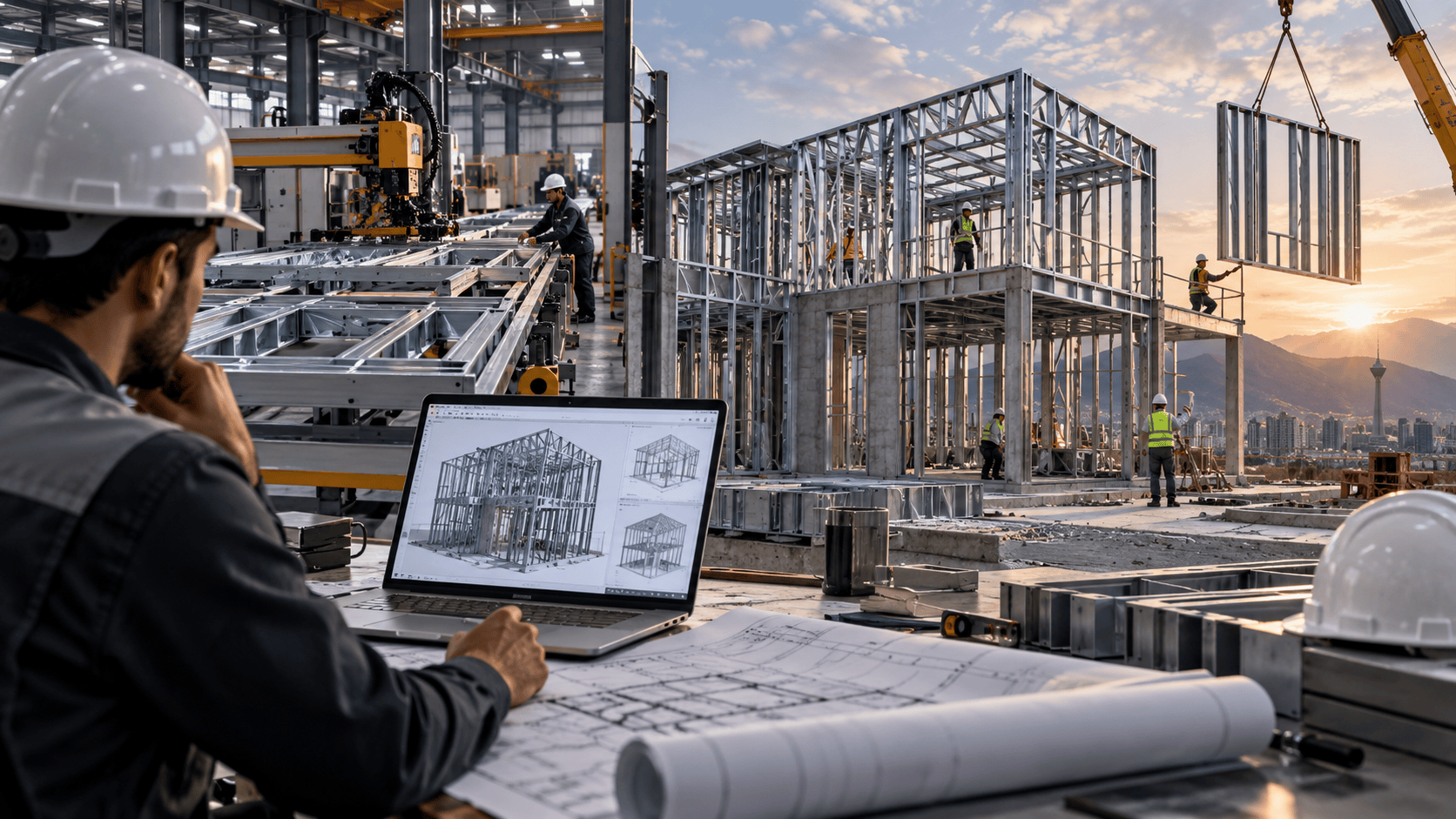
Industrialized construction should not be defined merely by the use of lightweight structures, prefabricated components, or modern machinery. True industrialization occurs when design, engineering, manufacturing, quality control, transportation, and assembly become integrated parts of a single process.
In technical literature, concepts such as standardization, integration, factory-based production, and reducing project-specific on-site operations are also regarded as key components of construction industrialization.
Source: ScienceDirect
From this perspective, many projects that appear to employ modern construction technologies have not yet become fully industrialized in terms of their management and execution processes.
Below are 10 of the most important mistakes commonly observed in this area.
Mistake 1: Selecting the Industrialized Construction System After Completing the Architectural Design
One of the most fundamental mistakes is to design a building without considering the construction system and, only after finalizing the architectural design, decide to build it using LSF or another industrialized construction system.
In industrialized construction, the construction system should be one of the inputs to architectural design.
Structural spans, opening dimensions, building heights, load paths, wall locations, MEP systems, and even certain façade details can affect structural design and manufacturing.
Therefore, the preferred process is not:
Architecture → System Selection → Architectural Revision → Structural Design
Instead, an integrated process should be established from the beginning:
Architecture + Structure + MEP + Manufacturing Requirements
This is precisely where the concept of Design for Manufacturing and Assembly (DfMA) becomes important.
Mistake 2: Assuming That Purchasing Machinery Means Becoming Industrialized
A precise and advanced production line is a significant advantage, but an industrialized factory is not simply a collection of machines.
Suppose a company owns the best manufacturing equipment available, but the production file contains an error.
What will the machine do?
It will manufacture the same error with high precision.
Machine accuracy therefore cannot replace engineering accuracy.
A truly industrialized manufacturing facility requires an integrated combination of:
Software + Engineering + Machinery + Skilled Operators + Quality Control + Information Management + Production Planning
A weakness in any one of these elements can affect the performance of the entire production chain.
Mistake 3: Comparing LSF Systems Only by Price per Kilogram
One of the most common questions in the LSF market is:
“What is the price of the structure per kilogram?”
Price is important, but price per kilogram alone is not an appropriate criterion for evaluating a building system.
Two proposals may have similar prices while differing substantially in structural design, material specifications, optimized structural weight, connection details, production control, engineering services, and installation quality.
A heavier structure does not necessarily mean a better structure.
Good engineering should aim to achieve the required performance through proper design and efficient use of materials.
Therefore, instead of comparing systems solely by price per kilogram, several factors should be evaluated:
- Design quality
- Steel sheet specifications
- Manufacturing process
- Connections
- Quality control
- Engineering services
- Assembly drawings
- Manufacturer responsibility
Mistake 4: Making Architectural Changes After the Project Has Entered Production
In conventional construction, moving a window during construction may appear relatively simple.
In an industrialized system, however, the same change may affect several different components.
Changing an opening can require modifications to studs, headers, load paths, the corresponding panel, production files, component identification codes, and even components that have already been manufactured.
One of the fundamental principles of industrialized construction is therefore:
Design freedom should exist before production, not after it.
As a project moves closer to production, changes should become increasingly controlled.
Mistake 5: Separating Design from Manufacturing Without a Defined Interface
One weakness in some projects is that design is performed by one organization, manufacturing by another, and installation by an entirely separate team, without clearly defining responsibility for transferring information between them.
This separation is not necessarily a problem in itself. The problem begins when the interfaces between these parties are not clearly defined.
Who is responsible for ensuring that the production file matches the structural drawings?
Who communicates architectural revisions to the manufacturing team?
Who approves the final drawing revision?
Who is responsible when a manufactured component does not match the approved design?
Industrialized construction requires clearly defined responsibilities and controlled information flow.
Mistake 6: Neglecting Component Identification and Coding
At first glance, component coding may seem like a minor issue.
However, imagine hundreds of LSF members arriving at a construction site and the installation team having to determine on site where each component belongs.
At that point, the process begins to resemble conventional construction again.
In an industrialized system, every component should have an identity.
Its identification code should make it possible to determine the panel, wall, or area of the building to which it belongs.
Proper component coding increases assembly speed, reduces human error, and improves traceability.
Mistake 7: Precision Manufacturing Combined with Non-Industrialized Installation
All components may be manufactured with high precision in the factory, but if the installation team continues to operate using conventional construction practices, much of the advantage of industrialized production will be lost.
LSF assembly requires compliance with approved drawings, installation sequences, connection types and quantities, verticality, levelness, construction tolerances, and engineering details.
Specialized standards for cold-formed steel structures also treat design, fabrication, installation, and the quality of members and connections as interrelated aspects of the system.
Source: Build Using Steel
It is therefore not possible to industrialize manufacturing while keeping installation entirely conventional and still expect a fully industrialized result.
Mistake 8: Neglecting MEP Coordination
One of the most costly mistakes is designing the structure without sufficient coordination with mechanical and electrical systems.
If service routes are not reviewed before manufacturing, the site team may later be forced to drill, cut, or modify structural members.
This is directly contrary to the philosophy of industrialized construction.
In an industrialized project, the following questions should, as far as possible, be answered before manufacturing begins:
- Where will pipes pass?
- What routes will electrical cables follow?
- Where will equipment be installed?
- Which openings need to be incorporated into the design and production process?
The objective is to solve problems before they reach the construction site, rather than solving them on site.
Mistake 9: Eliminating Quality Control Because Production Is Automated
One of the most dangerous assumptions is:
“The machine is automated, so the product must be correct.”
Automation can reduce certain types of human error, but it does not eliminate the need for quality control.
An industrialized process should include clearly defined inspection points, including:
- Raw material inspection
- Steel sheet thickness and specifications
- Dimensions
- Punches and openings
- Matching components with production information
- Component coding
- Condition of components before leaving the factory
Quality control should not begin only after a problem appears on site.
Quality control must be part of the manufacturing process, not a reaction to failure.
Mistake 10: Assuming Industrialization Simply Means Building Faster
Speed is one of the major advantages of industrialized construction systems, but speed alone is not the objective.
If a building is completed quickly but suffers from poor design, extensive rework, and uncontrolled quality, it cannot be considered a successful example of industrialization simply because construction was fast.
The primary objective should be to create a predictable process.
A process in which quality, schedule, material consumption, manufacturing stages, and installation activities can be planned and controlled to a reasonable degree.
Recent studies also identify the coordination of manufacturing and assembly, as well as the management of disruptions throughout the overall process, as important challenges in construction industrialization.
Source: ScienceDirect
An Important Question: Who Is a Real LSF Manufacturer?
After reviewing these mistakes, a more fundamental question can be raised:
Is every company that supplies LSF structures actually an LSF manufacturer?
From an industrial perspective, there is a significant difference between a seller, an installer, a procurement intermediary, and a manufacturer.
A true manufacturer should be able to directly manage and control the manufacturing process and establish a clear relationship between engineering drawings and the finished products leaving the factory.
When evaluating an LSF company, rather than relying solely on marketing claims, it is useful to ask:
- Where is the factory located?
- What equipment is used to manufacture the components?
- How are steel sheet specifications controlled?
- How are production files prepared and approved?
- How are components identified and coded?
- At which stages is quality control performed?
- Which organization is ultimately responsible for coordination between design, manufacturing, and installation?
The answers to these questions provide a much clearer picture of a company’s actual capabilities.
LSF Is Not Merely a Product; It Is a System
One of the most important changes in perspective is to stop viewing LSF as simply a collection of studs, tracks, joists, and screws.
LSF delivers its real value when it is treated as a system.
A system consisting of:
Architecture → Structural Calculations → Detailing → Production Files → Factory Manufacturing → Quality Control → Coding → Packaging → Transportation → Assembly → Cladding and Building Completion
Specialized cold-formed steel standards similarly treat design, fabrication, installation, and quality as interconnected components of the overall system.
Source: Build Using Steel
If only one stage is carried out professionally while the remaining stages operate without coordination, the full potential of the system cannot be achieved.
Industrialization Means Moving Decisions from the Construction Site to Engineering
Perhaps the most important difference between conventional and industrialized construction can be summarized in one sentence:
In conventional construction, many decisions are made on site; in industrialized construction, the objective is to make those decisions before production begins.
Every decision that can be transferred from the construction site to the pre-production engineering stage reduces project uncertainty.
For this reason, the future of construction industrialization does not lie solely in faster machinery.
The future lies in connecting design information to manufacturing and connecting manufacturing to assembly.
Research related to BIM and prefabricated manufacturing also emphasizes the importance of accurate information flow between design and construction.
Source: ScienceDirect
Iran’s Main Challenge: Technology or Construction Culture?
A significant portion of the technology required for industrialized construction is already available.
Manufacturing machinery has become more precise, design software has advanced, and systems such as LSF make it possible to transfer a considerable portion of construction activities to a controlled factory environment.
However, technology is only part of the issue.
If clients continue changing designs until the last moment; if architects design without understanding the structural system; if contractors are selected solely on the basis of the lowest price; if manufacturers lack proper quality control; and if installation teams work without assembly drawings, advanced machinery alone cannot industrialize construction.
Therefore, one of the greatest challenges facing the development of industrialized construction is changing project management culture from “solving problems during construction” to “preventing problems before production.”
Conclusion
Industrialized construction is not a machinery procurement project.
It is a transformation of the process.
Within this process, design must be developed for manufacturing, production must rely on controlled information, components must be traceable, and installation must be a logical continuation of the factory process.
LSF has considerable potential to support this approach. However, using lightweight steel profiles alone does not make a building industrialized.
LSF becomes truly industrialized when design, manufacturing, and installation form a single integrated chain.
Perhaps the most important criterion for identifying a genuinely industrialized project is this:
The fewer decisions that must be transferred to the construction site for resolution, and the more issues that are resolved through engineering before production begins, the closer the project is to genuine industrialized construction.
Aria Tadbir Pazh’s Perspective
At Aria Tadbir Pazh Engineering & Trading Company, LSF is not viewed merely as the sale of structural components or the manufacturing of steel profiles.
More than two decades of specialized experience in this field have shown that final project quality can only be achieved when design, factory manufacturing, quality control, and installation are treated as components of a single integrated process.
For this reason, the concept of a “true LSF manufacturer” is not merely a marketing phrase for us. It means accepting responsibility for a fundamental part of the industrialized construction chain.
Aria Tadbir Pazh
Design | Factory Manufacturing | Installation of LSF Light Steel Structures
Industrialization does not begin in the factory; it begins with engineering.

No comment